
Private Travel Tips
Private Jet Charter Broker vs Operator: Roles, Rules and Liability
By CERTIFIED JETS · July 19, 2026
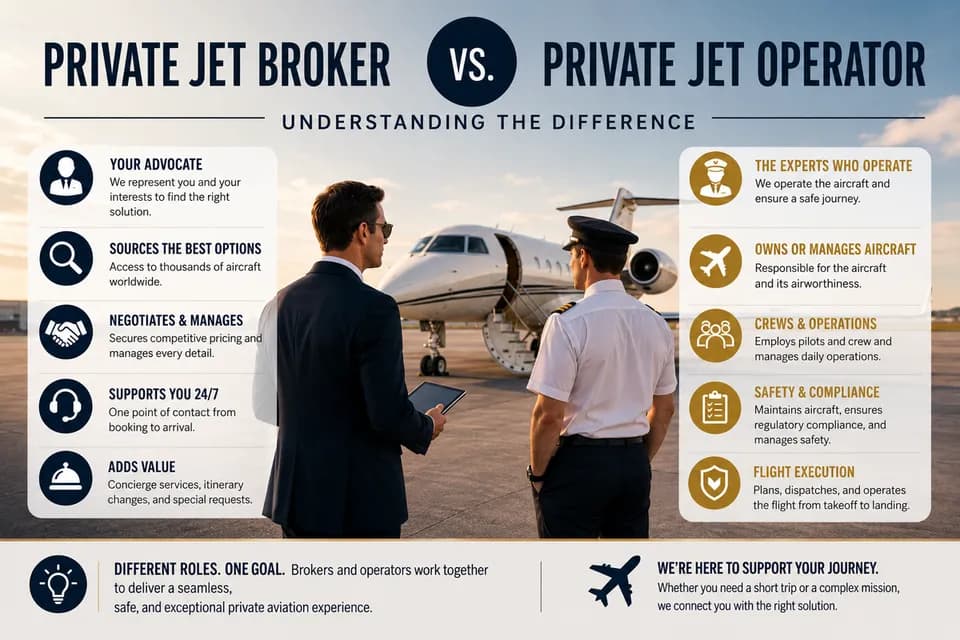
The difference between a private jet charter broker and an operator comes down to who operates the flight. A private jet operator is the company that holds the operating certificate for your flight and, under FAA rules, has operational control of it. A charter broker arranges the flight for you with an operator but does not operate the aircraft.
- The operator holds the certificate: in the US, an FAA certificate for Part 135 on-demand charter; in the UK and Europe, an Air Operator Certificate (AOC).
- US brokers must state that they are brokers, not operators, and must name the operator before you sign (or, if not yet known, within a reasonable time).
- In the UK, the Civil Aviation Authority says you must by law be told the name of the operator.
- Beyond those rules, read your charter contract to see what the broker has agreed to do.
Private Jet Charter Broker vs Operator at a Glance
| Charter operator | Charter broker | |
|---|---|---|
| The aircraft | Operates it. Each aircraft used for charter must be authorized under the operator's certificate. | Does not operate it. Arranges your flight with an operator. |
| Operating certificate | US: FAA certificate with operations specifications for Part 135. UK/EU: an AOC from the aviation authority. | None for your flight. In the US, brokers act under Department of Transportation rules in 14 CFR Part 295. |
| Responsibility for the flight | Holds operational control: authority over starting, conducting and ending the flight. | Not in operational control. In the US, Part 295 sets its disclosure, advertising and refund duties; also read your contract. |
| Who you contract with | The operator, directly. | As principal, the broker contracts with you and separately with the operator; as an agent, it acts for you or the operator. US brokers must say which. |
| Pricing | You receive its quote directly. | The total may include the broker's fees. US brokers must disclose the total cost, including their fees, if you ask; itemizing is not required. |
| Flexibility | Operates only aircraft authorized on its own certificate. | Can contract with more than one operator. |
What a Private Jet Broker Does
US federal rules define an air charter broker as a person or company that "holds out, sells, or arranges single entity charter air transportation using a direct air carrier." A single entity charter is one where the whole aircraft is chartered and the cost is borne by the charterer. The broker can act as a principal that contracts separately with the operator, or as a bona fide agent appointed by either the charterer or the operator.
Part 295 gives US flyers these protections when booking through a broker:
- Advertising, including websites, must state clearly that the company is an air charter broker, not a direct air carrier in operational control of aircraft.
- Before you sign, the broker must give you the corporate name of the operator, the capacity it is acting in, and whether it holds liability insurance covering you and your passengers, with the limits.
- On request, it must also disclose the total cost, third-party fees you will pay directly, and, if it is acting as your agent, any business relationship with the operator that may bear on its choice.
- If any of this is unknown when you sign or changes later, the broker must tell you within a reasonable time after it becomes available; failing that, it must offer you the chance to cancel with a full refund.
- Brokers may only arrange flights with operators that hold the required economic authority from the Department of Transportation and safety authority from the FAA (and, where applicable, a foreign safety authority).
How to choose a private jet broker
Judge a broker on transparency: the operator and aircraft named early, its capacity stated in writing, an all-in price, and a clear answer on what happens if the aircraft becomes unavailable. For a longer checklist, see how to choose the right private jet charter broker.
What a Charter Operator Is: the Certificate (AOC) Holder
In the US, a company flying on-demand charter as a direct air carrier must hold an FAA certificate and operations specifications and conduct those flights under Part 135. The FAA defines operational control as "the exercise of authority over initiating, conducting or terminating a flight," and its rules state that each Part 135 certificate holder is responsible for operational control.
The FAA advises charter customers to ask to see the operator's Air Carrier or Operating Certificate. It also publishes a Part 135 operators and aircraft list, searchable by operator name or aircraft registration and, the FAA says, updated weekly, so you can check whether an operator is certificated and which aircraft are authorized for charter. If an operator or aircraft is not listed, the FAA says to contact the local Flight Standards District Office.
In the UK and Europe, the equivalent is the Air Operator Certificate. EASA describes an AOC as a certificate that allows an operator to perform specific commercial air transport operations, normally issued by the aviation authority of the country where the operator has its principal place of business. Compared with a private jet broker, then, the AOC holder is the operator of the flight; a broker acting as a broker is not.
Charter Broker vs Operator: Who Is Responsible for the Flight?
Under FAA rules, operational control of a Part 135 charter flight rests with the certificate holder. The FAA lists as a red flag any company that provides the aircraft and at least one crew member yet tries to transfer operational control to the customer through a document. If paperwork suggests you are in operational control, ask why.
Part 295 does not say who is liable for the flight. It sets a US broker's disclosure, advertising and refund duties, including prompt refunds when the flight cannot be performed, and it treats misrepresenting that passengers are directly insured, when they are not, as a deceptive practice. Beyond that, read the charter agreement: the contracting party, substitution rights, cancellation terms, liability limits and governing law. This is general information, not legal advice; for a high-value or unusual contract, have a lawyer review it.
Operator vs Broker: Where Safety Standards Sit
The FAA says Part 135 charter requires a higher level of pilot training and certification, maintenance procedures and safety rules than flights by private pilots carrying family or friends. Under Part 295, a US broker may not arrange flights with unauthorized operators, and it may not misrepresent pilots' qualifications or the safety record or certification of pilots, aircraft or carriers.
The same rules prohibit brokers from misrepresenting their membership in, or involvement with, an organization that audits brokers or carriers, or misrepresenting that they or a carrier meet an auditing organization's standard. If a company cites a safety audit, ask which organization, standard and date, then confirm it with that organization. PJReviews does not assess any company's safety. For the questions to put to the operator itself, see these safety questions to ask before you book.
Management Companies, Central Agents and Who Represents Whom
Aircraft management company vs charter broker
If a company says it manages the aircraft, ask whether that aircraft is on its own operating certificate or another company's; the FAA list shows which operator each authorized aircraft sits under. If you own an aircraft and are comparing managers, see questions to ask an aircraft management provider.
Charter broker vs central agent
Some companies describe themselves as a central or exclusive agent for particular aircraft. Part 295 does not use those terms. What it does require is that a US broker tell you whether it is acting as principal, as your agent, or as the operator's agent. A broker acting as the operator's agent acts on the operator's behalf; if you want someone representing you, ask for that in writing.
Broker vs Operator in London and the UK
The UK Civil Aviation Authority says a paid flight in a business jet is commercial air transport and should never be treated as a private arrangement, and that the operator must hold the correct certificate, insurance and licences. It notes that the company selling you the flight may not be the operator, and that by law you must be told the operator's name. You can then check the CAA's list of UK AOC holders, and the CAA also suggests asking for the pilot's name and qualifications. If the operator's certificate was issued in another country, check with that country's aviation authority. You can browse private jet providers in London on PJReviews and ask each one which role it plays on your flight.
Charter Operator vs Listing Platform: Where PJReviews Fits
PJReviews is a directory that lists private aviation companies, including brokers and operators. It does not operate aircraft or sell flights, and it is not part of the booking: you contact the provider and book directly with them. A listing on PJReviews is not an endorsement, recommendation or certification of the company, so treat it as a starting point and confirm the operator's certificate with the regulator yourself.
Questions to Ask Before You Book
- Are you the operator of this flight, or a broker? If a broker, in what capacity are you acting?
- What is the operator's full corporate name, and which certificate will the flight be conducted under?
- What is the aircraft's registration, and is it authorized under that certificate?
- Is the price all-in, and which third-party fees will I pay directly?
- What liability insurance covers my passengers, whose is it, and what are the limits?
- Can the aircraft or operator be substituted, and do I have to agree first?
- What are the cancellation and refund terms?
- Who is the named contracting party on the charter agreement and the invoice?
FAQ
Is it better to book with a direct operator or a broker?
Neither route suits everyone. Booking direct means contracting with the company that controls the aircraft; a broker gives you one contact that can approach several operators. Either way, confirm the operator and aircraft.
Does a broker cost more?
A broker's fees may be built into the total, so compare all-in quotes for the same aircraft, route and dates. In the US you can ask the broker to disclose the total cost including its fees.
Can a company be both a broker and an operator?
Part 295 applies by role: it covers any person or company acting as an air charter broker. Ask which role the company is playing on your flight.
Does a PJReviews listing mean a company is certificated?
No. Check US operators against the FAA's Part 135 list and UK operators against the CAA's list of AOC holders.
Browse private jet providers on PJReviews.com, compare how each describes its role, read member reviews, and book directly once you have confirmed who will operate your flight. For the full booking process, see our private jet charter guide.